

The Full Day Matters: TK Schedules vs. A Complete Montessori 3-6 Experience
Why Continuity and Depth Across the Entire Day Make a Difference for Young Children in California
Welcome to the third installment in our series helping California families navigate early learning choices. In previous posts we covered the optional nature of TK and took a close look at curriculum approaches. This month we turn to a practical but powerful question: What does the full day actually look like?
For working families especially, the hours between drop-off and pick-up; and what fills them; can be one of the most important factors in choosing care.
TK Daily Reality
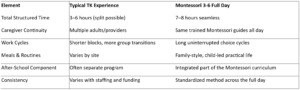
Transitional Kindergarten is required to offer a minimum of about three hours of instructional time per day, with many programs running 3–4+ hours. Some districts provide full-day options (up to roughly 6 hours) by combining TK with Expanded Learning Opportunities Program (ELO-P) funding or other wraparound care.
This can be convenient and free. However, the experience is often split:
- Morning/afternoon TK session with credentialed teachers following the school’s TK curriculum.
- Before-and after-school care handled by a different program or provider.
Quality and programming in the wraparound hours vary widely by district and site. Some offer enriching activities; others focus more on supervision. Transitions between caregivers, environments, and expectations multiple times a day are common for many TK children.
The Montessori Full-Day Difference
A Montessori 3-6 program is designed as one complete, seamless experience from arrival to departure, typically 7–8 hours in a full-day setting. There are no major hand-offs or shifts in philosophy.
What a typical full day includes:
- Arrival & Morning Work Cycle — Children choose activities from the prepared environment. Long, uninterrupted blocks of time (often 2–3 hours) allow deep concentration and repeated practice.
- Group Lessons & Practical Life — Small-group presentations, grace-and-courtesy exercises, snack preparation, and care of the classroom.
- Outdoor Time — Movement, nature exploration, and gross-motor development.
- Lunch & Rest — Family-style meals where children serve themselves and practice social skills. Rest areas for younger children who need naps.
- Afternoon Work Cycle — Continued choice with materials, cultural extensions, art, music, and peaceful winding down.
- Departure — Consistent routines with the same trained guides throughout.
Every moment is part of the Montessori curriculum. The same highly credentialed teachers who lead the morning also guide the afternoon. This continuity builds security, trust, and steady progress.
Why the Full Day Matters at Ages 3–6
Young children thrive on predictability and relationships. Frequent transitions can be tiring and fragment attention. A unified full-day program allows:
- Longer periods for concentration to develop naturally.
- Consistent modeling of social skills and emotional regulation by the same adults.
- Integration of practical life skills across meals, clean-up, and care of self and environment.
- Reduced stress for both child and parent—no rush to switch programs or wonder what happened during aftercare.
Montessori’s mixed-age community also means older children help care for younger ones all day long, strengthening empathy and leadership in real time.
Side-by-Side Look at the Day
Questions Worth Asking About Daily Structure
- What does the full schedule look like from drop-off to pick-up?
- Who is responsible for the child during every part of the day, and what training do they have?
- How are transitions handled, and how much uninterrupted work time is there?
- For TK families: What activities are offered in before/after care, and how do they connect to the TK curriculum?
- How does the program support children who need rest or active movement throughout the day?
- May I see a sample daily rhythm and observe during different parts of the day?
Looking Ahead
Next month we’ll explore social-emotional development and independence; two areas where Montessori classrooms often shine because of the prepared environment and multi-year community.
Myth 3: Public TK offers the same full-day, consistent experience as a dedicated early childhood program.
Reality: TK minimum instructional time is often just 3–4 hours. Many children then move to separate after-school care with different staff and varying quality. A full-day Montessori program provides one seamless philosophy and the same trained guides across 7–8 hours.