November in Our Classrooms: Asia, Fish, and Leaves
Each month, our cultural curriculum gives children new ways to explore the world around them. In November, our classrooms are focusing on Asia in geography, fish in zoology, and leaves in botany.
At MSOSV, children often begin with concrete materials before moving toward more abstract ideas. As they study Asia, children may work with maps, globes, flags, photographs, and classified cards. Younger children begin by locating Asia on a globe or identifying its shape on a puzzle map. Older children explore individual countries, land and water forms, landmarks, plants, animals, languages, clothing, music, art, or daily life. These experiences help children understand geography as more than a place on a map. They begin to see the connections between people, culture, and the natural environment.
Our zoology focus on fish offers another opportunity for close observation and precise language. Children identify the parts of a fish, including its fins, gills, scales, and tail, and consider how each part helps a fish live and move in water. Depending on their age and readiness, they may match pictures, sort different kinds of fish, label diagrams, or learn about habitats and life cycles. Hands-on materials allow children to examine one idea at a time, then organize those details into a fuller understanding of the animal.
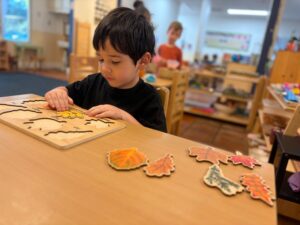 In botany, children will explore leaves through observation, comparison, and classification. They collect leaves outdoors, notice similarities and differences in their shapes and edges, or use Montessori botany materials to identify the parts of a leaf. Younger children can build vocabulary through matching and naming, while older children label leaf structures, compare leaf shapes, or consider the role leaves play in helping a plant grow. Working with real specimens alongside classroom materials helps children connect what they’re learning to the trees and plants they encounter every day.
Across all three topics, guides prepare materials and experiences based on the children’s ages, interests, and readiness. Because our classrooms are multi-age communities, younger children can learn by observing their older classmates, while older children return to familiar subjects with greater detail and independence. The emphasis isn’t simply on memorizing facts. Children are learning how to observe carefully, ask questions, build vocabulary, classify information, and make connections across subjects.
Our November special event is the Thanksgiving Feast on November 19th. Children will help prepare food in their classrooms, share dishes across the school, and enjoy the meal together. Older children will also have opportunities to help serve their classmates. It’s a practical, child-centered way to practice independence while contributing to the community.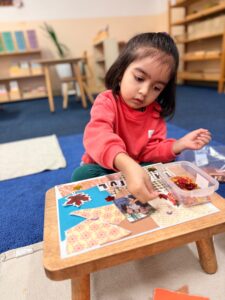
We look forward to sharing photos from this month’s work through Transparent Classroom.