
Building Independence and Emotional Strength: How Montessori 3-6 and TK Support Young Children Differently
Why Self-Regulation, Confidence, and Social Skills at Ages 3–6 Set the Foundation for Long-Term Success
Hello again and thank you for following this monthly series. We’ve discussed TK options, curriculum approaches, and the importance of a full, consistent day. This month we focus on one of the most meaningful aspects of early childhood: social-emotional development and independence.
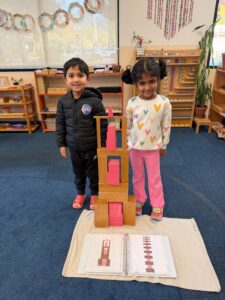 These years are when children build the internal tools; focus, self-control, empathy, and confidence, that support learning and relationships for the rest of their lives.
Social-Emotional Growth in TK
Public Transitional Kindergarten classrooms emphasize kindness, sharing, emotional vocabulary, and group cooperation. Many programs have adopted strong social-emotional curricula and prioritize play-based activities that help children learn to navigate friendships and conflicts.
Because TK serves children who are often experiencing a first structured school setting, teachers work hard to create welcoming routines. As programs have shifted toward more play, opportunities for imaginative and cooperative play have increased, which supports emotional growth.
Consistency can vary, however. With shorter days, multiple caregivers, and annual changes in staffing or emphasis, children may need to adapt to new expectations several times.
The Montessori Approach to Independence and Emotional Development
Montessori classrooms are intentionally designed to nurture the whole child’s inner drive toward independence. Key features include:
- Freedom with Responsibility — Children choose their work, but they also learn to respect the materials, clean up after themselves, and consider others. This builds genuine self-discipline rather than external control.
- Grace and Courtesy — Explicit lessons in polite language, conflict resolution, and caring for others are practiced daily (e.g., “May I join you?” or helping a friend who is upset).
- Mixed-Age Community — Three- to six-year-olds together create natural opportunities for mentoring. Older children reinforce their own learning by helping younger ones; younger children gain confidence from observing capable peers.
- Practical Life Activities — Pouring water, preparing snacks, buttoning, sweeping, and caring for plants give children real skills and a powerful sense of “I can do it myself.”
- Emotional Regulation — Long work cycles allow children to experience the satisfaction of mastering a challenge. When frustration arises, guides help children name feelings and find peaceful solutions instead of stepping in immediately.
Because the same trained guides stay with the group across the full day and often across multiple years, relationships deepen and support is consistent.
Side-by-Side Comparison
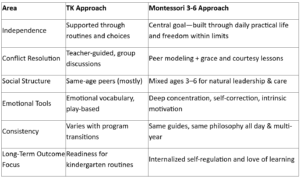
Both approaches help children grow socially and emotionally. Montessori’s design simply makes these skills an integrated part of every moment rather than add-on lessons.
What Parents Often Notice
Families frequently tell us their children become more helpful at home, show greater patience with challenges, and resolve sibling conflicts more peacefully after time in a Montessori environment. These are natural results of practiced independence and community living. TK families often report their children gain confidence in group settings and school routines; valuable skills for the kindergarten transition.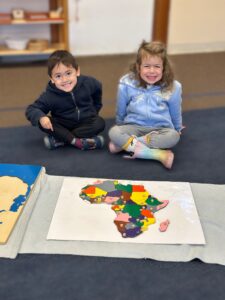
Questions Worth Asking About Social-Emotional Growth
- How does the program teach children to handle conflicts or big feelings?
- What opportunities do children have for real responsibility and independence each day?
- How are different personalities and developmental stages supported in the same space?
- For TK: How do social-emotional goals connect between the TK day and aftercare?
- Can I observe how children interact during free-choice time and group activities?
- How does the program measure and support progress in self-regulation and empathy?
Next Month in the Series
We’ll look at academic readiness and long-term outcomes, how children from both paths typically perform once they reach kindergarten and beyond.
Myth 4: TK curriculum is stable and proven specifically for 4-year-olds.
Reality: TK has changed significantly in its short history; from modified/dumbed-down kindergarten, to worksheets, to stations, and now a stronger emphasis on play. Montessori’s 3–6 curriculum has remained consistent and refined for over 100 years because it is built specifically for this developmental stage.