
Montessori 3-6 vs. TK Curriculum: Stability, Play, and What Really Works for 4-Year-Olds
Exploring How California’s Public TK Has Evolved and Why Montessori’s Proven Approach Offers Consistency for Young Learners
Welcome back to our monthly series on early learning choices in California. Last month we covered the big picture: TK is optional, full of potential, and one of several good paths available to families. This month, we take a closer look at the heart of any program, the curriculum, and how it supports (or sometimes challenges) the natural development of 4 and 5 year-olds.
Our goal remains the same: to share clear, respectful information so you can make confident decisions for your child.
How TK Curriculum Has Evolved
When Transitional Kindergarten first expanded, many classrooms started with a “modified kindergarten” approach. Teachers adapted existing K materials for younger children. In practice, this sometimes-meant worksheets, desk work, and more academic pacing than most 4-year-olds were ready for.
Over the following years, educators and researchers observed what many parents and Montessori guides already knew: young children learn best through movement, play, and hands-on exploration; not prolonged sitting or paper-based tasks. California has responded by shifting emphasis toward developmentally appropriate, play-based learning. Recent guidance encourages classrooms that prioritize joy, curiosity, and social-emotional growth while still preparing children for kindergarten.
This evolution is positive. Many TK teachers now use learning stations, manipulatives, outdoor play, and thematic activities. However, because TK is implemented locally, experiences still vary widely from district to district and year to year. Curriculum materials, daily schedules, and the balance between play and structure can change as new teachers join or policies shift.
The Montessori 3-6 Advantage: A Time-Tested Foundation
Montessori’s 3-6 (Primary) program was designed over a century ago specifically for this exact age group, and it has remained remarkably consistent because it works. It is not “modified” anything. It is a complete, holistic curriculum built around how children naturally develop during these sensitive years.
Key elements include:
- Hands-on Materials — Beautiful, concrete tools for math (golden beads, spindles), language (sandpaper letters, movable alphabet), sensorial exploration (color tablets, geometric solids), and practical life (pouring, buttoning, food preparation). Children manipulate these materials themselves, moving from concrete to abstract understanding at their own pace.
- Mixed-Age Community — 3- to 6-year-olds learn together. Older children model and teach; younger ones gain confidence and inspiration. This builds leadership, empathy, and collaboration naturally.
- Freedom Within Limits — Children choose work that interests them during long, uninterrupted morning and afternoon work cycles. This fosters deep concentration, intrinsic motivation, and self-discipline.
- Play as Learning — Montessori recognizes that “play is the work of the child.” Purposeful, self-directed activity is valued far more than adult-directed lessons or worksheets.
- Integrated Day — Practical life, grace and courtesy, art, music, science, and cultural studies weave throughout the day in a seamless flow.
Because the method is standardized through accredited training, families enjoy remarkable consistency from classroom to classroom and year to year.
Side-by-Side Comparison
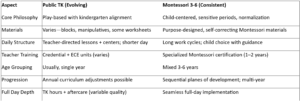 Both approaches value play. The difference lies in depth, consistency, and how completely the environment is prepared for the whole child—academically, socially, emotionally, and practically.
What This Means for Your Child
Four-year-old’s are wired to explore, move, repeat activities until mastered, and build real skills through doing. A stable, rich environment that respects this wiring helps children develop strong executive function, joy in learning, and confidence that carries into kindergarten and beyond.
Many Montessori graduates transition beautifully into public schools—often standing out for their focus, independence, and love of learning. At the same time, children from strong TK programs also do well. The question is which environment best matches your family’s values and your child’s temperament right now.
Questions Worth Asking About Curriculum
- Can I see examples of the daily schedule and sample activities?
- How much time do children spend in self-directed, hands-on work versus teacher-led group time?
- What training and support do teachers receive specifically for 4-year-olds?
- How does the program handle different learning paces within the same classroom?
- For TK: How consistent will the approach be next year?
- May I observe during a work cycle to see children’s concentration and independence in action?
Coming Next Month
We’ll explore the full-day experience: TK hours versus a complete Montessori day, including what happens during after-school hours and why continuity matters so much at this age.
Myth 2: TK is essentially required or the “only responsible choice” for getting your child ready for kindergarten.
Reality: TK is optional for families. Compulsory education in California begins at age 6. Many children thrive with private preschool, home-based care, or other programs and enter kindergarten successfully. Quality early experiences matter more than the specific public option.